About
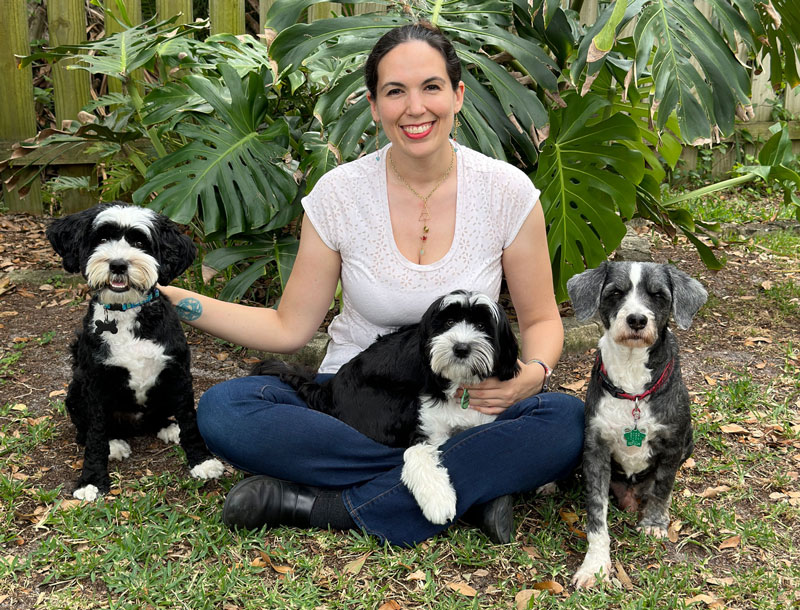
Kestrel Michaud is a classically-trained, imaginative realism fine artist with a passion for illustrating in fabric. She started working with fabric in 2004 as a Junior in high school. By the time she graduated in 2006, Kestrel had developed her own unique style and technique and had completed almost 30 unique fabric pictures. Her work was hanging and selling in galleries across Pennsylvania as part of the National Road Heritage Corridor program. Kestrel had also won more than 50 local, regional, national, and international awards for her artwork, including a Grand Prize for the Student Art Competition at the 62nd World Science Fiction Convention when she was 15 years old.
Kestrel attended the Ringling College of Art and Design, beginning in the fall of 2006. Although her entire admissions portfolio was comprised of fabric artwork, she tried to avoid fabric in college and focus on other media instead because she didn’t think fabric had a future. But once Kestrel’s professors saw her online fabric portfolio, they wouldn't let Kestrel work in any other medium. Kestrel’s senior thesis of six gallery-sized fabric artworks were made entirely from fabric. In 2010, Kestrel graduated with honors and a Bachelor of Fine Arts in Illustration, having gained an extensive understanding of how to create captivating works of art out of fabric.
Until 2017, Kestrel worked as a full-time graphic designer, working with organizations including Judith Leiber, Kenneth Cole, and NASA. That year, her passion for fabric was reawakened by discovering there were other artists in the world using fabric to create art. Kestrel made her first art quilt in 2018, won her first major award in 2019, and has gone on to win top prizes at quilt shows across the country. In 2021, Kestrel won a Grand Prize at the International Quilt Festival in Houston, the largest quilt festival in the world. Her works have also traveled to galleries, museums, and quilt shows across the US and internationally to countries including France, England, South Korea, the Czech Republic, and Australia.
All of Kestrel’s quilts are in the style of imaginative realism. Kestrel has an entire imaginary steampunk world in her head, complete with characters, locations, and events. Kestrel combines the lessons about visual storytelling she learned in college with her talent working with fabric to create quilts that tell stories from this fictional realm in a visual style that makes the imagery look real, even though it’s not.
Kestrel’s technical style is called fused, raw-edge appliqué, and her quilts are notably different from her early fabric pictures because the fabric pictures did not include stitching. Each quilt is comprised of hundreds or thousands of individual pieces of fabric, some even smaller than the tip of a fingernail. Kestrel cuts and assemble them like a puzzle made from overlapping pieces. Each piece of fabric is fused in place with a heat-sensitive fabric glue before being quilted at a density of 1/8”-1/16”. Kestrel stitches her designs by free-motion quilting, which means she moves the fabric under the needle of her sewing machine to “draw” lines out of thread.
Kestrel is also pioneering the use of technology in quilt design and creation. Her process for creating her work is entirely self-developed, and after learning about art quilts in 2017, she pushed to convert her formerly analog process to digital. She draws her designs on an iPad, develops a full pattern in Illustrator, uses a Cricut cutting machine to cut her fabrics, and developed a method to entirely prevent the fabric from fraying. She has also invented a process to accurately select fabrics for her digital designs using self-created paper color swatches.
Today, Kestrel works as a full-time, professional quilt artist, exhibiting and selling her work around the world. She also shares her knowledge by teaching her process through Patreon, live and virtual lectures, and live workshops. In 2023, Kestrel was invited to be a guest on The Quilt Show and Quilting Arts TV. The former was published on July 30, 2023 (episode #3303). The latter aired on PBS in December 2023 (episodes 3001, 3003, 3007). Kestrel and her work have been featured in a number of magazines, including Quilting Arts Magazine, Quiltfolk, and Art Quilting Studio. Her work has graced the covers of bUneke magazine and the SAQA Journal. Her fine art training, creative mind, inventive nature, decades of experience, and unique style make Kestrel’s work unlike that of any other artist.
Professional Connections
- Board Member of Studio Art Quilt Associates (SAQA)
- Member of SAQA Global Exhibition Committee
- Member of SAQA Special Events Committee
- Member of Florida Artists Group (FLAG)
- Marquis Who's Who Listee
Media
- ARJJ Corporation. (2023, July 30). "A Mod Podge Appliqué Technique and Fabric Selection with Kestrel Michaud." The Quilt Show. episode #3301. Link
- Michaud, K. (2023, July). “Not Today.” American Quilter July 2023. Paducah, KY; American Quilter’s Society. 68.
- Michaud, K. (2023, June). “Beauty Queen.” Quilting Arts Magazine, Summer 2023(118), Golden Peak Media, Golden, CO, 2023, p. 30.
- Brubaker Knapp, S. (2023, June). “Artist Profile: Kestrel Michaud.” Quilting Arts Magazine, Summer 2023(118), 51–53.
- DeNegre, V.H. and Michaud, K. (2023, June.) ‘Show Us Your Studio’, Quilting Arts Studio, Summer 2023(118). 54-57.
- Michaud, K. (2023, February). “Leap of Faith.” Quilting Arts Magazine, Spring 2023(117), Golden Peak Media, Golden, CO, 2023, p. 31.
- Michaud, K. (2023). “Luke, Artist Proof.” Quilltfolk Dogs. Eugene, OR; Quiltfolk. 22.
- Maslowski, B. and Michaud, K. (2022, July 12). “QOF Episode 74 with Kestrel Michaud.” Quilter on Fire Podcast. Link
- Anderson, A., & Michaud, K. (2021, November 29). “AlexLIVE-Kestrel Michaud - Steampunk Quilts - How did she do that?” The Quilt Show, YouTube. Link
- Walton, L., & Michaud, K. (2021, October 21). “ARTIST STORY - Kestrel Michaud shares how she creates her quilts with thousands of pieces - AMAZING.” YouTube. Link
- Michaud, K. (2021, June). “Leap of Faith.” bUneke Magazine(20). Cover. Link
- Brotherton, M. (2021, June). “Melbourne Artist Give Back in a Beautiful Way.” bUneke Magazine(20), 8–11. Link
- Michaud, K. (2021, July 21). “Luke.” Inspired to Sew(92). SCHMETNeedles. Link
- Michaud, K. (2020, December). “The Last Page” feat. “Best Friends”. Art Quilting Studio Winter 2021.
- Sielman, M., & Michaud, K. (2020, July 27). “Conversations with the Artists: Aloft.” Textile Talks. Studio Art Quilt Associates. Link
- Michaud, K. (2020). “Steampunk Puppy LE 01/10.” SAQA Journal. Hebron, CT; Studio Art Quilt Associates. Cover.