New Thread, New Needles
- Published:
- Length: 972 words
- Reading Time: 5 minutes
I use 100wt silk thread as my default choice for quilting because I love how subtle it is. Almost always, my priority is for the fabric to make the first impression on viewers. The thread is supporting that first view; it's present but unquestionably second to the fabric.
Having said that, however, I do continue to look for opportunities when other types of thread would work. The catch is that whatever new thread I use has to add something to the visual design that the fabric alone cannot do. Not every quilt design I make has an opportunity for a new type of thread; those occasions are much more the exception than the norm. But my newest quilt is one of those exceptions.
This is High Stakes, and I am planning to use a thread that is NOT 100wt silk for the background.
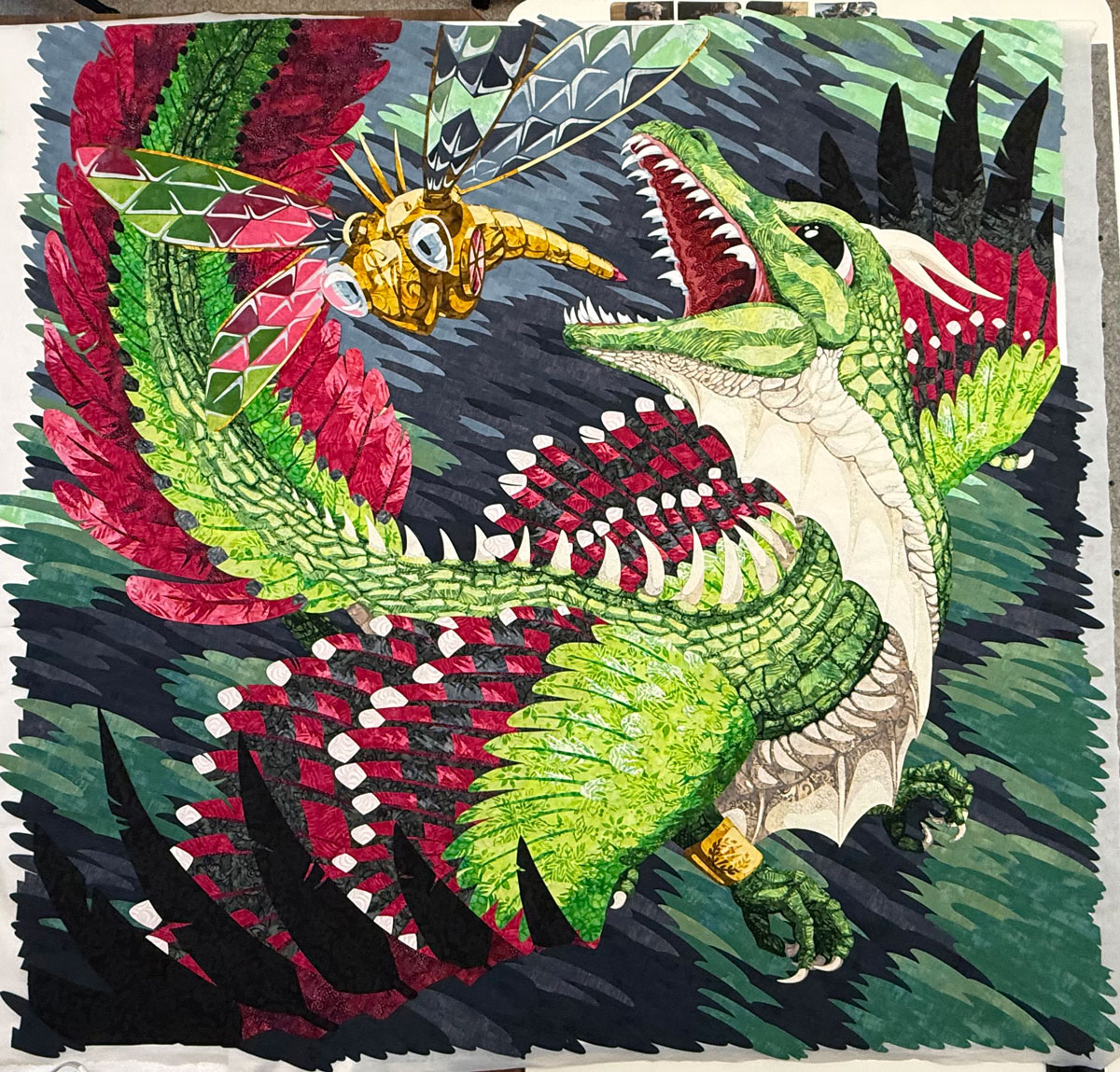
The dragon and the dragonfly are moving fast, and the background is supposed to look like a motion-blur effect. Here's where the opportunity for new thread comes in: I'm going to use a 40wt variegated thread to create a stripey, striated pattern that will enhance the motion-blur effect I'm hoping to create.
But I've never quilted with 40wt thread, which brings us to the point of this blog post. I likely need a different needle for such a drastically different thread. This is how I figured out what needle would work best for me.
Baseline
I have three baseline pieces of information going into this series of tests:
My Quilts: All of my quilts are created the same way, which means I'm always sewing through the same materials. Those materials include mod podge-treated fabrics, Hotfix fusible, and wool/rayon felt.
Kimono Silk Needle: My Q20 likes 80/12 Microtex needles when sewing 100wt silk thread. Those are the needles that have been working for my type of quilting for years.
King Tut Needle: King Tut is the type of thread I will be using for the background. Superior Threads, the manufacturer, recommends using a 90/14 Topstitch needle.
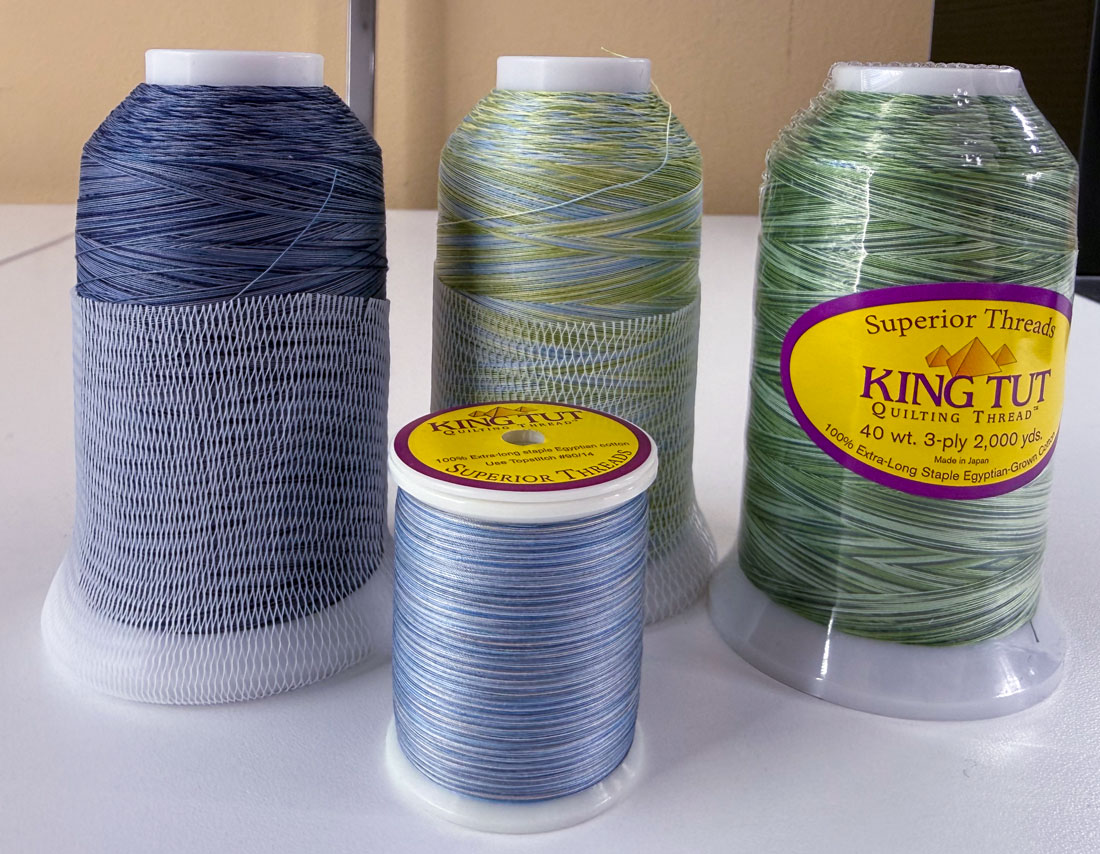
With all of this in mind, it was time to start testing.
The Testing
The key to testing is to only change one variable at a time, but I needed to start with a set of constants.
Constant #1: The King Tut thread. I knew this is the thread I would be using for the background of my design.
Constant #2: The tester quilt sandwich. I made a small quilt sandwich using scrap fabric left over from the cutting process, so it was essentially a much smaller version of the real deal.
There were to variables:
Variable #1: The bobbin thread. I would try the MicroQuilter (100wt polyester) I use when sewing Kimono Silk and MasterPiece (50wt cotton) that Superior Threads recommends using with King Tut.
Variable #2: The needle. My options were 80/12 Microtex, 80/12 Topstitch, and 90/14 Topstitch. (Microtex are sharp needles, which are normally great for punching through my treated, fusible-backed fabric. But Superior Threads recommends Topstitch for King Tut.)
All in all, there are only 6 possible combinations of variables, so I wasn't facing an enormous task. But only one of those combinations would work, and I had to find it.
The Result
I tried all six combinations of needles and bobbin threads, making sure to recalibrate my bobbin case's tension when switching the bobbin threads, and I did finally find one combination that I was happy with. (Arrow markers are described below image.)
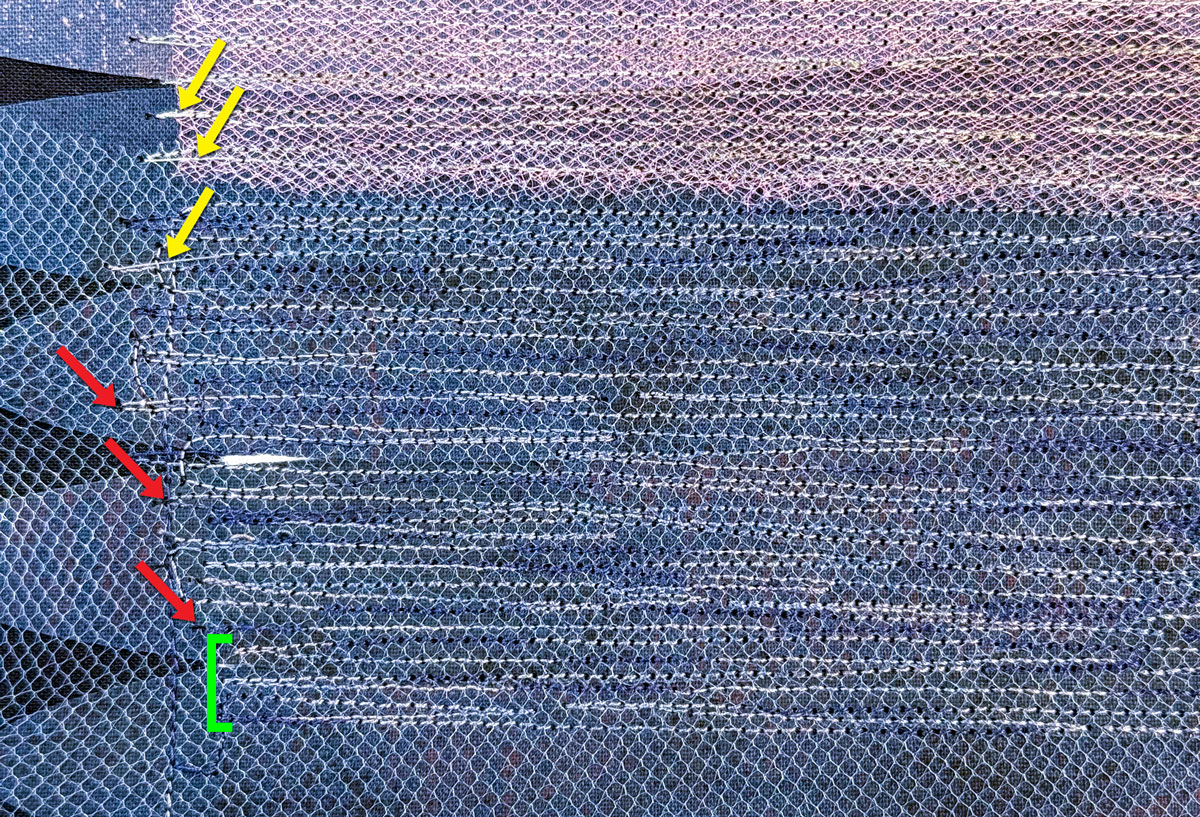
The 80/12 Microtex needle resulted in consistent skipped stitches with both bobbin threads (see yellow arrows).
The 90/14 Topstitch needle was much better with skipped stitches, but I was seeing the black bobbin thread pull to the top when I changed direction with a sharp point (see red arrows).
The 80/12 Topstitch was the best (see green bracket). I did not see any bobbin thread pulled to the top on turns. I did have a small number of skipped stitches, but they only happened if I went super fast while quilting away from me. If I was careful about moderating my speed, I did not see any skipped stitches. That's a very manageable factor, so I wasn't worried about that on my real quilt.
The two bobbin threads provided similar results, so I decided to go with MasterPiece on the real quilt. Since it's a much thicker thread than the MicroQuilter, I reasoned it would be easier to get the tension balanced correctly.
The Real Deal
As of writing this blog post, I've begun stitching my dragon quilt. And although I intitially went with MasterPiece in the bobbin, I switched to MicroQuilter after the first hour of stitching. I was seeing spots of top thread on the back, and also spots of bobbin thread on the top, which was weird to have happen at the same time. I finally guessed that because my quilt is so thin, there just isn't space to effectively and consistently hide the loops within the quilt sandwich.
Why didn't I have that problem in testing? I really don't know. All I can figure is quilting the actual quilt, which is significantly bigger than my test quilt sandwich, was affecting the thread in a way that didn't happen on the test sandwich. Which is a good lesson in itself: Testing ahead of the main project is great, but it's worth continuing to monitor and be willing to make adjustments as needed.
Switching to MicroQuilter in the bobbin solved the problem, though, so that's what I'll be using for the rest of this quilt.